
You are comparing two roof quotes after a North Carolina storm, and both contractors are saying the same thing:
“This is a high-wind shingle.”
One quote has GAF Timberline HDZ.
The other has Owens Corning Duration.
From the driveway, they both look like architectural shingles. Both are major brands. Both are common on homes across North Carolina.
So which one actually wins when the wind picks up?
Here’s what that usually means.
Quick Answer
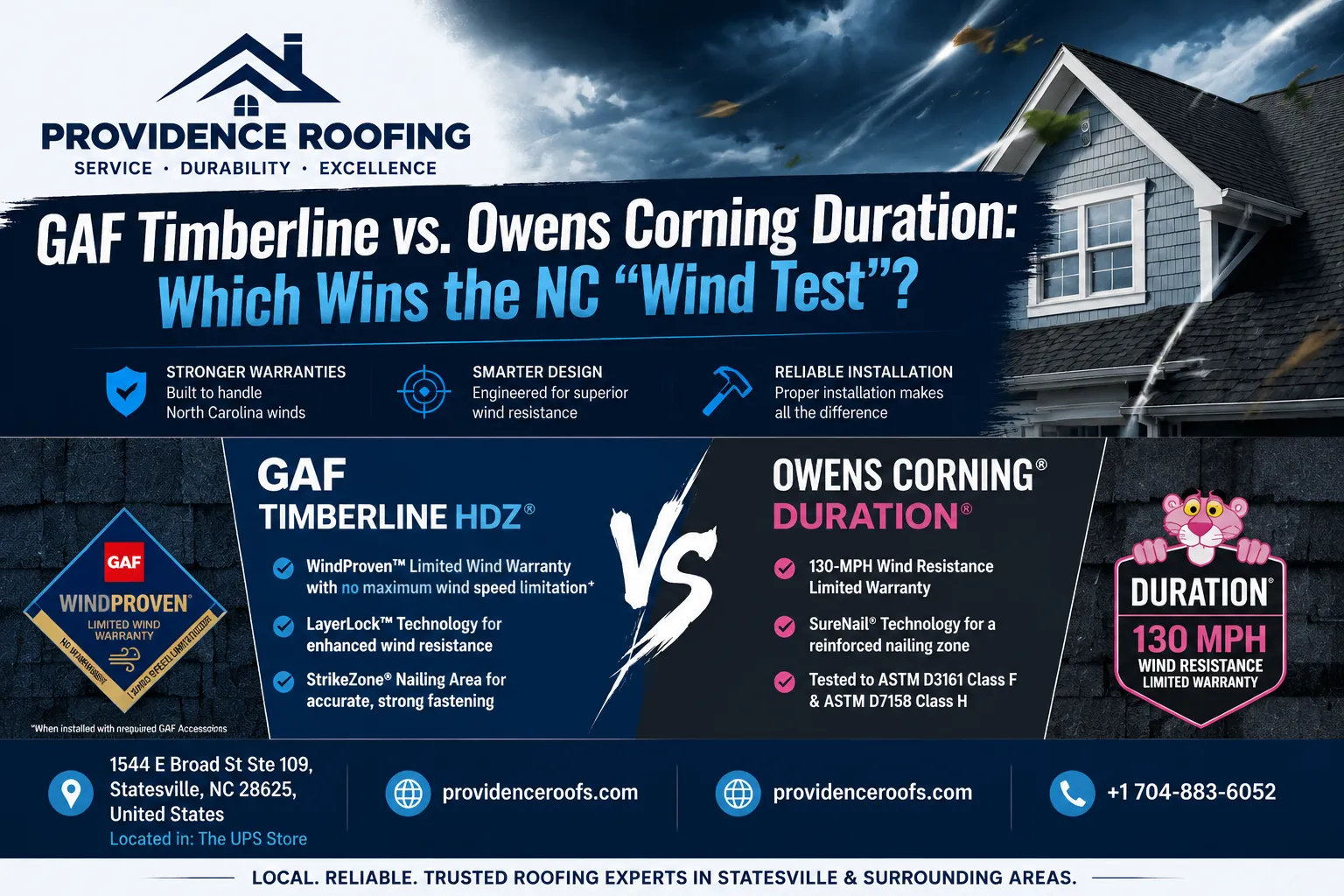
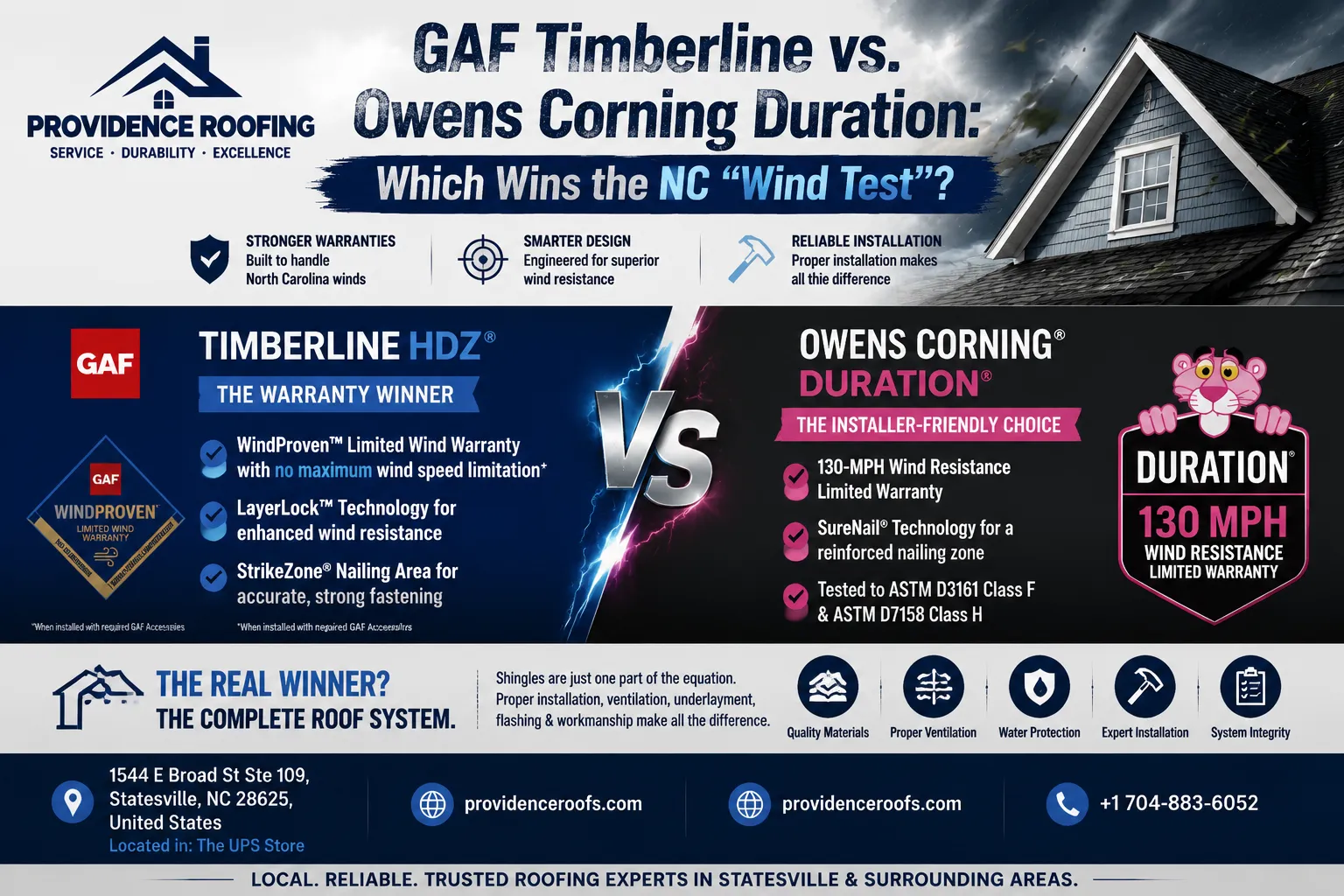
For the strongest wind warranty on paper, GAF Timberline HDZ wins because it can qualify for GAF’s WindProven Limited Wind Warranty with no maximum wind speed limitation when installed with the required GAF accessory system.
For the most forgiving nailing-zone design, Owens Corning Duration is very strong because its SureNail Technology gives installers a reinforced nailing area, and Duration shingles carry a 130-MPH Wind Resistance Limited Warranty.
For most North Carolina homeowners, the real answer is this:
GAF wins the warranty “wind test.” Owens Corning wins points for installer-friendly nailing design. The actual roof wins only if the contractor installs the full system correctly.
A poorly installed GAF roof can fail.
A poorly installed Owens Corning roof can fail.
A properly installed roof system matters more than the logo on the bundle.
The North Carolina Wind Test Is Not Just One Big Hurricane
When people hear “wind damage,” they often picture coastal hurricane winds.
But most North Carolina roof damage does not happen that neatly.
In Hickory and Morganton, wind-driven rain comes over the foothills and pushes under weak edges. In Boone, steep rooflines, mountain gusts, snow, and freeze-thaw cycles stress shingles differently. In Huntersville and Statesville, fast-moving storm lines can lift shingles on exposed suburban roofs. In Carolina Shores, coastal systems bring stronger wind, humidity, salt air, and driving rain. In Winston-Salem and the Triad, hail and straight-line wind can expose weak installation fast.
That is the real NC wind test:
- Repeated thunderstorm gusts
- Wind-driven rain
- Heat cycling
- Shingle expansion and contraction
- Edge lift at eaves and rakes
- Poor attic ventilation
- Aging sealant strips
- Bad nailing
- Missing starter shingles
- Reused flashing
- Cheap underlayment shortcuts
A shingle does not fight wind by itself. The whole roof system does.
Round 1: Wind Warranty
GAF Timberline HDZ
GAF Timberline HDZ shingles with LayerLock Technology may qualify for GAF’s WindProven Limited Wind Warranty, which GAF describes as having no maximum wind speed limitation when installed with the required combination of GAF accessories.
That is the strongest wind-warranty language between these two products.
But there is a catch homeowners need to understand.
The no-limit wind warranty is not automatic just because the contractor uses GAF shingles. GAF says the WindProven warranty requires Timberline shingles with LayerLock Technology plus required qualifying accessories, including items such as starter strips, roof deck protection, ridge cap shingles, and either leak barrier or attic ventilation.
So the real question is not:
“Are these GAF shingles?”
The better question is:
“Is this being installed as a qualifying GAF roofing system?”
Owens Corning Duration
Owens Corning Duration shingles are also built for wind resistance. Owens Corning lists Duration shingles with a 130-MPH Wind Resistance Limited Warranty, and product data for Duration Premium also states a limited lifetime warranty and 130-MPH wind resistance limited warranty.
Owens Corning also publishes that its asphalt shingles are tested and certified to ASTM D3161 Class F and ASTM D7158 Class H wind resistance classifications, which it describes as the highest available wind classifications and applicable across U.S. geographic areas under building-code wind classification standards.
Winner: GAF Timberline HDZ
On warranty language alone, GAF wins because “no maximum wind speed limitation” is stronger than a 130-MPH wind warranty.
But read that carefully.
It wins when installed as a qualifying system.
Round 2: Nailing Zone and Installation Forgiveness
This is where Owens Corning makes the strongest argument.
Owens Corning Duration shingles use SureNail Technology, a reinforced nailing zone designed to improve fastening performance where the nails go. Owens Corning describes Duration shingles as featuring its patented SureNail Technology.
Why does that matter?
Because wind resistance often fails at the nail line.
If nails are too high, too low, overdriven, underdriven, angled, or missed from the reinforced zone, the shingle may not perform the way the warranty brochure says it should.
A clear, reinforced nailing strip can help the installer hit the right target. That is valuable on a real jobsite, especially on steep roofs, hot days, cold mornings, or complicated roof planes.
GAF has its own installation advantage too. Timberline HDZ uses LayerLock Technology and the StrikeZone nailing area. GAF’s materials describe LayerLock as mechanically fusing the common bond between overlapping shingle layers and creating a wide nailing area.
So both brands are trying to solve the same problem:
Keep the shingle properly fastened so wind cannot lift it.
Winner: Slight edge to Owens Corning Duration
Owens Corning’s SureNail design is one of the clearest nailing-zone stories in roofing. GAF’s StrikeZone is also strong, but Duration gets the edge for installer-friendly fastening design.
Round 3: Full Roof System Protection
This is where homeowners need to slow down.
A high-wind shingle installed over a weak roof system is still a weak roof.
Wind does not only attack the center of the shingle. It attacks:
- Eaves
- Rakes
- Valleys
- Ridge lines
- Hip lines
- Starter courses
- Flashing transitions
- Pipe boots
- Skylights
- Chimneys
- Wall intersections
That is why starter shingles, underlayment, leak barriers, ridge caps, flashing, and ventilation matter.
GAF’s strongest wind warranty is tied directly to system installation. That can be a benefit because it forces the conversation beyond “what shingle are we using?” and into “what roof system are we building?”
Owens Corning also offers full roofing system components, but in this head-to-head wind comparison, GAF’s WindProven structure makes the system requirement especially clear.
Winner: GAF Timberline HDZ
GAF wins this round because the strongest wind warranty depends on a broader installed system, which is exactly how homeowners should think about wind protection.
Round 4: North Carolina Use Case
Here is how I would think about this in different parts of North Carolina.
Boone
For Boone homes, wind is not the only issue. Steep slopes, snow, ice, freeze-thaw cycles, and mountain weather all matter. Either product can work, but installation details are critical. Proper underlayment, ice and water protection in vulnerable areas, flashing, and ventilation may matter more than the brand.
Best fit: Either, if installed by a roofer who understands mountain roof conditions.
Hickory and Morganton
Foothills roofs often deal with tree coverage, wind-driven rain, shade, and older homes. Algae resistance, ventilation, and flashing details matter. Wind can expose weak edges and old decking.
Best fit: GAF if the homeowner wants the strongest wind-warranty structure; Owens Corning if the contractor’s installation quality and SureNail system are the stronger fit.
Huntersville and Statesville
Suburban homes with larger rooflines can catch storm gusts across open neighborhoods. This is where wind-rated installation details matter. Rakes, eaves, ridge caps, and starter shingles need to be right.
Best fit: Slight edge to GAF for wind warranty, but only with the required accessories.
Carolina Shores
Coastal wind, humidity, salt air, and storm systems raise the stakes. A roof near the coast should be judged as a system, not just shingles. Edge protection and warranty requirements matter.
Best fit: GAF for the stronger wind-warranty language, assuming the full qualifying system is installed.
Winston-Salem and the Triad
The Triad gets mixed storm threats: wind, hail, rain, and heat. Both products are common choices. The roof’s age, decking condition, and attic ventilation should drive the recommendation.
Best fit: Either product can be right. Installation quality decides the winner.
The Honest Comparison
| Category | GAF Timberline HDZ | Owens Corning Duration | Winner |
| Wind warranty | WindProven warranty may have no maximum wind speed limit with required accessories | 130-MPH Wind Resistance Limited Warranty | GAF |
| Nailing-zone design | StrikeZone nailing area with LayerLock Technology | SureNail reinforced nailing zone | Owens Corning |
| System requirement clarity | Strong emphasis on qualifying GAF accessory system | Strong product line and system options | GAF |
| NC storm suitability | Strong fit when installed as full system | Strong fit with excellent fastening design | Tie |
| Best for coastal/wind-focused homeowners | Very strong warranty position | Strong, but capped wind warranty | GAF |
| Best for installation forgiveness | Good nailing area | Excellent reinforced nailing strip | Owens Corning |
So Which One Wins?
If we are testing based on wind warranty, the winner is:
GAF Timberline HDZ
GAF’s WindProven Limited Wind Warranty with no maximum wind speed limitation gives it the strongest wind-warranty position, as long as the roof is installed with the required qualifying accessories.
But if we are testing based on nailing-zone design, Owens Corning Duration deserves serious respect. SureNail Technology is a strong installation feature, and the 130-MPH wind warranty is still more than enough for many inland North Carolina homes when the roof is installed correctly.
The practical answer:
Choose GAF Timberline HDZ if wind warranty coverage is your top priority. Choose Owens Corning Duration if you trust the installer and value the SureNail fastening design. Choose neither if the contractor cannot explain the full roof system.
The Bigger Issue: Bad Installation Can Beat Any Shingle
This is the part most homeowners miss.
Wind failure usually comes from one of these problems:
- Missing starter shingles
- Poor nail placement
- Overdriven nails
- Too few nails
- Weak decking
- Improper ventilation
- Reused flashing
- Exposed or lifted edges
- Cheap ridge cap substitutions
- Incorrect underlayment
- Poor sealing in cold weather
- No attention to roof transitions
A premium shingle cannot overcome sloppy installation.
A good roofer should be able to show you:
- What underlayment is included
- What starter shingles are being used
- What ridge cap is included
- Whether leak barrier is included
- Whether attic ventilation is being corrected
- Whether decking will be inspected
- What warranty applies
- What could void that warranty
Don’t just ask which brand is better.
Ask what is actually being installed.
Questions to Ask Before Choosing GAF or Owens Corning
Before you sign a roof replacement contract, ask:
- Is this a full roofing system or just shingles?
- What wind warranty does this exact installation qualify for?
- Are starter shingles included at the eaves and rakes?
- Are ridge cap shingles included, or are you cutting field shingles?
- What underlayment and leak barrier are included?
- How will you handle ventilation?
- What happens if decking is soft or damaged?
- Can you show me the manufacturer requirements in writing?
- What workmanship warranty comes from the contractor?
- What could void the manufacturer warranty?
The contractor’s answers will tell you more than the shingle brand.
Bottom Line
For the North Carolina “wind test,” GAF Timberline HDZ wins on wind warranty because of the WindProven Limited Wind Warranty with no maximum wind speed limitation when installed with the required GAF accessories.
Owens Corning Duration is still a strong shingle, especially because of its SureNail reinforced nailing zone and 130-MPH wind warranty.
But the real winner is the roof system that is installed correctly.
If you are comparing GAF Timberline HDZ and Owens Corning Duration for a home in Hickory, Huntersville, Statesville, Boone, Morganton, Carolina Shores, Winston-Salem, or the Triad, Providence Roofing can inspect your roof, explain which system makes sense for your home, and help you choose the option that protects the house without overspending.